
The Scent of Kings: A Portrait of Oud
A complete beginner's guide to oud — how it forms, why it is rare, and how to actually understand it as a fragrance.
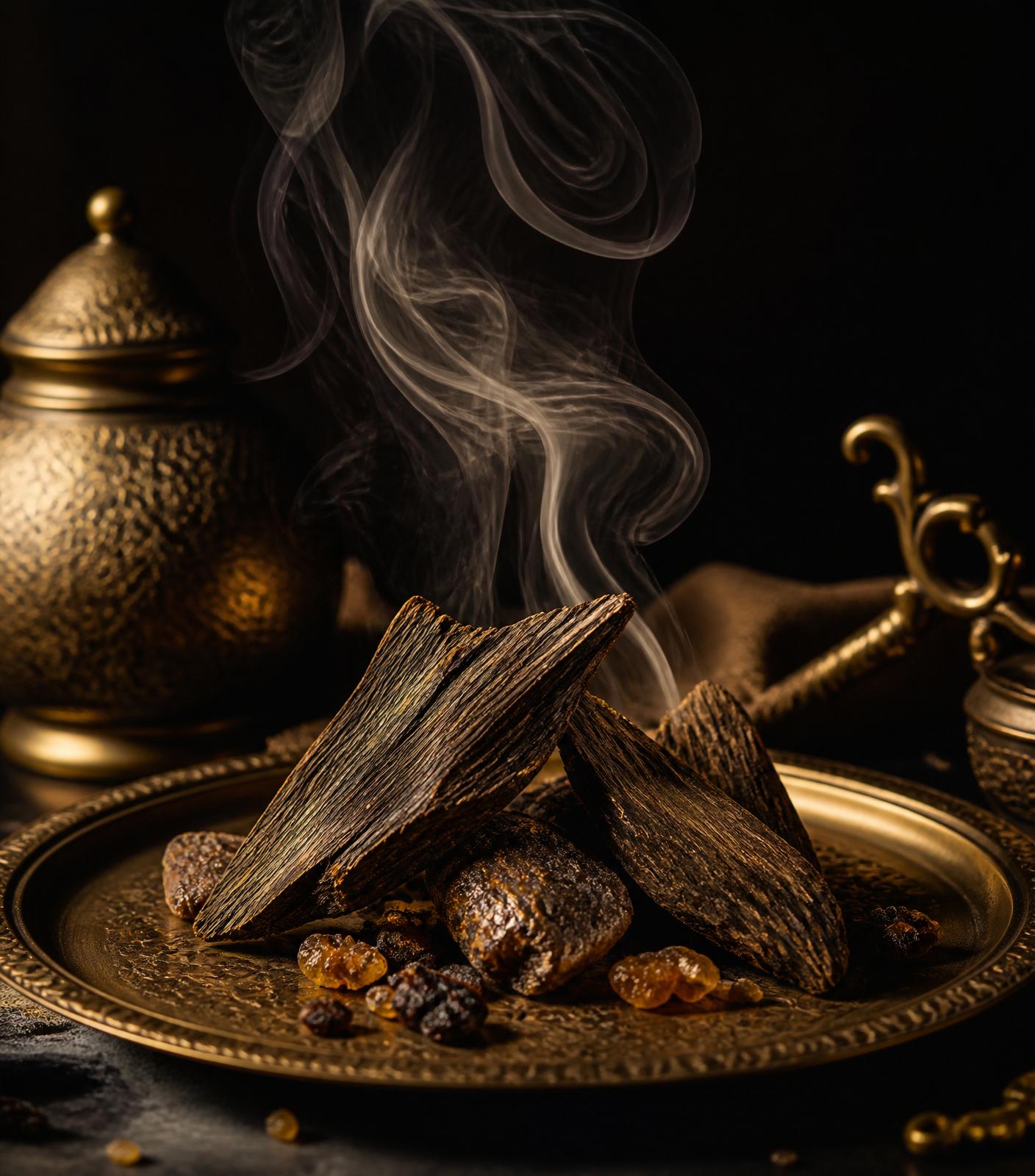
Very few materials in perfumery carry the weight that oud does. It has been burned in Arabian homes for centuries, offered to guests as a mark of honour, and traded along the same routes as silk, spice and incense. Today it appears on the ingredient list of nearly every serious luxury fragrance house — yet most people who wear it have never been told what it actually is.
This guide is written for the curious beginner. If you have ever wondered what oud smells like, why it costs what it costs, or how to wear it without overwhelming the room, start here.
“Oud is not a scent you announce. It is a scent that answers back.”
What is oud, exactly?
Oud — also written oudh, oud oil, dehn al oud, agarwood or aloeswood — is a fragrant, dark resin that forms inside certain tropical trees. The most common source is the Aquilaria genus, with Gyrinops as a close relative. These trees grow across South and Southeast Asia, from Assam and Bangladesh through Cambodia, Vietnam, Thailand, Malaysia, Indonesia and the Philippines.
In their natural state, these trees are pale and almost odourless. The resin — the material we call oud — only forms as a defence response. When the tree is wounded by wind, insects, or a specific mould, it produces a dark, aromatic resin that saturates the surrounding heartwood. That resin-infused wood is agarwood.
So oud is not a flower, a spice, or a wood in the ordinary sense. It is a tree's response to injury — a slow, defensive alchemy that can take years or even decades to fully develop.
Why oud is so rare (and so expensive)
Only a small percentage of wild Aquilaria trees ever produce meaningful amounts of resin. Even in a mature stand, the majority of trees hold no oud at all. The rest carry only faint pockets. High-grade material — dense, dark, sinker-quality wood — is exceptional.
On top of that, real oud takes patience. The resin develops slowly. Distilling oud oil is equally slow: chips are soaked, then steam-distilled for days, producing tiny yields of a viscous, deeply pigmented oil.
There is also a sustainability layer worth taking seriously. Wild agarwood has been over-harvested in many regions, and international trade in Aquilaria is regulated under CITES. Responsible modern oud increasingly comes from cultivated plantations where trees are grown for years, deliberately inoculated to encourage resin formation, and harvested with more oversight. When you see 'sustainable' oud, that is usually what is meant.
What oud actually smells like
There is no single 'oud smell'. Real oud is closer to wine than to a raw ingredient: origin, tree age, method and aging all change the profile.
You will hear the same words recur — woody, animalic, resinous, smoky, leathery, sweet, mossy, barnyard. In the best oils, all of that resolves into something surprisingly warm and almost meditative. In lesser ones, it can read sharp or medicinal at first.
Broad regional shorthand, kept honest:
• Hindi and Assam oud — often described as intense, animalic, and deeply resinous.
• Cambodian (Cambodi) oud — typically sweeter, softer, with a warm woodiness many beginners find easier.
• Malaysian, Bornean and Indonesian ouds — often greener, drier, sometimes with a cool, incense-like edge.
None of this is a rulebook. Two barrels from the same forest can smell like different materials. Treat regional profiles as a starting map, not a promise.
Bakhoor, dehn al oud, and mukhallat
In an Arabian household, oud typically arrives in one of three forms. Recognising them makes the whole world of Arabian perfumery easier to read.
Bakhoor is fragrant wood — often oud chips or a compounded blend — burned on a charcoal disc or an electric mabkhara. Guests are welcomed into rooms scented with it; clothing and hair are often perfumed in its smoke.
Dehn al oud is pure oud oil, distilled from agarwood chips. It is applied by the drop, warmed between the fingertips and traced onto the wrists, behind the ears, on the beard or in the hair. A single vial can last years.
Mukhallat means 'blend' — a compounded perfume oil that pairs oud with rose, saffron, amber, musk, sandalwood, and other notes. Most people's first experience of oud in a Western context is inside a mukhallat or a modern alcohol-based fragrance built around one.
Natural oud vs synthetic oud
Most 'oud' fragrances on the mainstream market do not contain much — or any — real oud oil. Instead they use a family of synthetic aromachemicals designed to evoke the impression of oud: warm, woody, slightly leathery, easier to project.
That is not automatically bad. Well-composed synthetic-oud fragrances can be beautiful. But they are a different object from real dehn al oud, and it helps to know which you are wearing. Natural oud is quieter, slower, and much more particular. It rewards close attention rather than a room-filling projection.
A useful mental model: synthetic oud is a portrait of oud. Real oud is the sitter.
How to understand oud as a beginner
You do not need to buy an expensive vial to start learning. Instead, build up references slowly.
Smell oud in more than one form. If you can, experience bakhoor once, a mukhallat once, and a modern oud-forward fragrance once. Notice how the same word — 'oud' — is doing very different work each time.
Give it time on skin. Oud opens in stages. The first minute is rarely representative. Wait ten, then thirty. The scent you meet at the two-hour mark is the one that will stay with you.
Do not try to like it immediately. Oud is one of the few notes in perfumery that many people need to grow into. That process is part of the pleasure.
How to wear oud (without overwhelming a room)
The single most common mistake is applying too much. Oud is dense; a little travels further than you expect, especially in warm weather.
Start with one point of contact — the inside of a wrist, or the base of the throat. Warm it for a moment between your fingertips before pressing it in. Do not rub aggressively; that flattens the top notes.
Layer it under, not over. A perfumed body oil applied first gives oud a soft canvas and lengthens its stay on skin. If you finish with an alcohol-based fragrance later, mist it above the collarbone rather than on top of the oil.
And leave a little room in the composition. Real elegance with oud is almost always about restraint.
Where to begin with oud
At its most elegant, oud is treated as a quiet centrepiece rather than a statement — warmed by amber, softened by resin, and given the space to settle rather than perform.
If you are new to Arabian-inspired perfumery, oud is a wonderful place to start reading. Everything else in the tradition — rose, amber, musk, saffron, sandalwood — eventually finds its way back to it.
Frequently Asked
- Is oud the same as agarwood?
- Effectively yes. Agarwood is the resin-infused wood. Oud usually refers either to that wood or, more often in perfumery, to the oil distilled from it.
- Why is real oud so expensive?
- Only a small fraction of wild Aquilaria trees produce resin, distillation yields are tiny, and high-grade material takes years to develop. Combined with strict trade regulation, that pushes prices very high.
- Does oud smell like a barnyard?
- Some traditional Hindi-style ouds have a strong animalic opening that can read that way for the first few minutes. Most modern and Cambodian-style ouds are much sweeter and softer. Give any oud time on skin before judging it.
- Is oud safe to wear on skin?
- Perfume-grade oud oil is generally well tolerated, but any concentrated fragrance material can irritate sensitive skin. If you are new to oud, patch test on a small area first.
- How much oud should I apply?
- Far less than you think. One small trace at a pulse point is usually plenty, especially in warm weather.
Be the first to know when the house opens.
A small circle. The occasional letter. No noise.